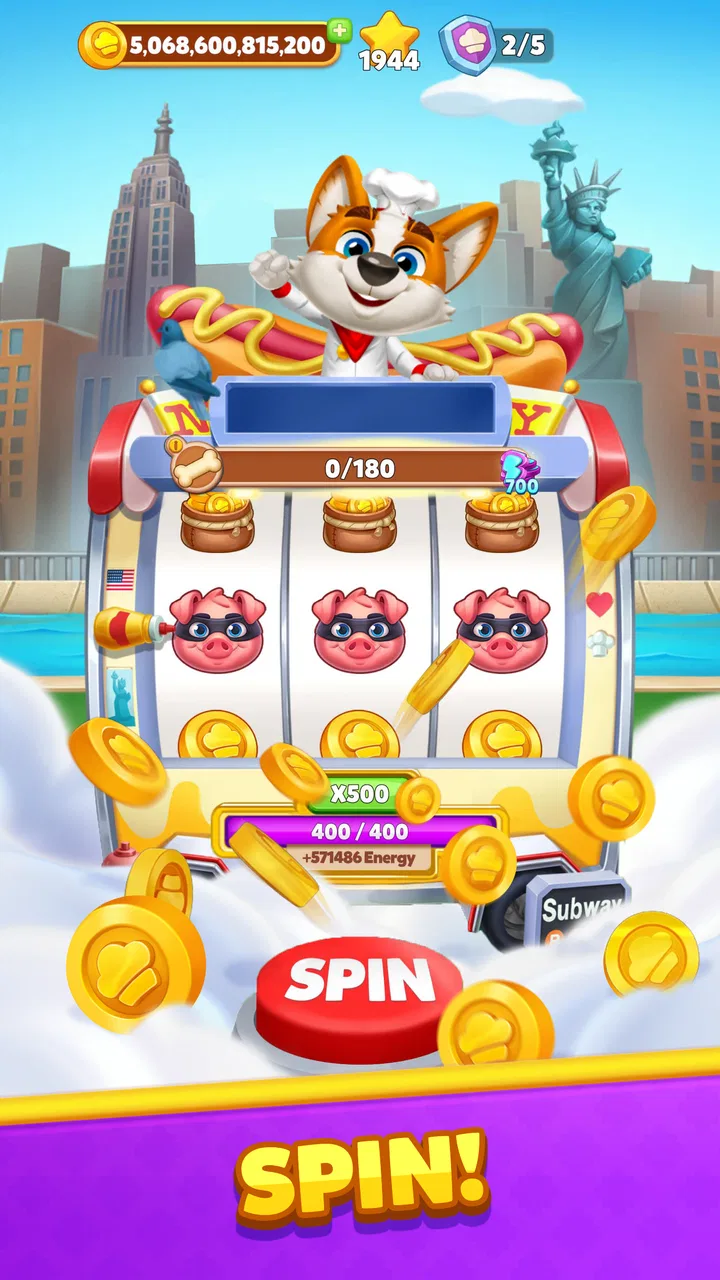
Coin Chef
- 4.6
- Rating
- 1.00M
- Installs
- Free
- Price

 Analysis by App-foxy
Coin Chef is a casual game built around one clear idea: I raid, loot, and attack to build up coins while interacting with friends. That focus makes it easy to understand within a few minutes, but the real appeal is not simply collecting currency. It is the way each action turns a small amount of free time into a choice between pushing my own progress and interfering with someone else’s. If you enjoy light competitive games that work in short sessions, this one has a pleasant pick-up-and-play rhythm.
After spending time with it, I would describe the social raid loop as its defining capability. Coin Chef is not trying to be a deep strategy game or a long-form role-playing adventure. It is a casual title from Fortune Mine Games, and its design is much closer to a quick daily game than to something that demands a long uninterrupted sitting. I can open it, make a few decisions, collect what is available, and leave without feeling that I have lost the thread.
The game is free to install, which makes trying it straightforward. It is rated Teen, and that is worth keeping in mind for younger players and families because the competitive attack theme and optional purchases are part of the experience. The in-app purchase range runs from $0.99 to $99.99 per item, so I would approach the game with a spending limit in mind rather than treating every tempting offer as part of normal progress.
You May Also Like

 Google Keep - Notes and lists
Google Keep’s Quiet Growth Shows the Appeal of Simpler Notes
As mobile work gets busier, Google Keep keeps winning a simple contest: capture a thought quickly, find it later, and get on with the day.

 Blood Strike: 2.5 Anniversary
Blood Strike’s Loadouts Turn Every Drop Into a Tactical Gamble
A close look at Blood Strike’s custom loadouts: how fast access to signature weapons reshapes its battle royale rhythm, rewards preparation, and narrows the gap between fights.

 Pandora - Music & Podcasts
Pandora’s Music Is Easy to Start, but Harder to Recover
Pandora’s strength is its low-effort path from a seed to a station. Its weak spot is how much confidence it asks you to place in connection, setup, and quiet recovery.

 8 Ball Pool
 Is Built on Rivalries, Rematches, and Routine
A close look at the rivalries, rematches, shared routines, and unanswered safety questions that turn a quick pool match into a persistent mobile community.

 Samsung Music
’s Quiet Strength Is Playing What You Already Own
Its reach comes less from spectacle than from dependable access to a personal library. That simplicity is both the app’s strongest retention engine and its ceiling.

 AccuWeather: Weather Radar
AccuWeather Review: A Quick, Clear Forecast for Everyday Decisions
For everyday plans, the best forecast is the one you can understand quickly. AccuWeather makes rain timing, radar, and local conditions easy to act on, with a few trade-offs.
More From Our News Desk



Why the raid-and-loot capability matters
Many casual games offer collecting, upgrading, or attacking as separate activities. Coin Chef makes these ideas feed into one another. Coins are not just a score sitting in the corner of the screen; they give the session a purpose. Raiding gives me a reason to return, looting adds a little surprise, and attacking friends makes the otherwise familiar collection cycle feel personal.
That last part changes the mood of the game. In a purely solo coin collector, my progress is mostly a private checklist. Here, the possibility of targeting a friend gives each session a small social edge. I am not only asking, “What can I afford next?” I am also thinking about which action will create the most satisfying result before I close the app.
The strongest part of Coin Chef is the short decision cycle, not mechanical complexity. I can play casually without studying a large rulebook, yet the raid-and-attack structure gives me more to consider than a simple idle counter. The game works best when I want a few playful choices, not when I am searching for detailed tactical control.
Its popularity also suggests that the basic loop has broad appeal. The game has passed a million installs, with an average rating of 4.6 from roughly twenty-six thousand ratings and about three thousand three hundred written reviews. Those figures do not guarantee that every player will enjoy it, but they fit my impression that the concept is accessible and easy to revisit.
What I actually do during a session
I begin by checking what is available to collect or use, then decide whether I want to concentrate on building my own coin total or take a more aggressive route through the social side. The important point is that the game does not require a long preparation phase. I can understand the immediate objective quickly, which is exactly what I want from a casual game on a short break.
Raiding is the part that gives progress some movement. Instead of waiting passively for a number to rise, I am encouraged to take action. Looting adds the possibility that a session will produce something more interesting than a predictable reward. Attacking friends, meanwhile, turns the friend list into more than a decorative feature. It gives me a reason to notice who is playing and to treat progress as something shared, even when the competition is lighthearted.
The game’s “piggy bank” idea also gives the coin goal a recognizable shape. I am not collecting an abstract resource with no emotional connection; I am working toward a visibly satisfying stash. That framing is simple, but it helps explain why the loop can remain appealing after the initial tutorial period. The reward is easy to understand, and the next action is usually obvious.
How the rhythm feels in everyday use
I found Coin Chef most comfortable in brief visits. Imagine waiting for a train, taking a coffee break, or winding down before bed. I can open the game, complete a small round of activity, check my coin position, and put it away. It does not ask me to reserve an entire evening, and that makes it easier to fit into a routine than a demanding strategy game.
There is also a useful psychological difference between a short session that ends with a clear result and one that ends because I have run out of time. Coin Chef generally supports the first kind. I can make progress in a compact window, which makes the game feel rewarding even when I am not playing frequently.
On the other hand, players who want every action to have a carefully planned long-term consequence may find the loop too light. The game’s strength is its immediacy. That same immediacy means it is not the best substitute for a complex empire builder, a competitive tactics game, or a story-driven adventure.
Using the social side without making it stressful
The friend-focused design is most enjoyable when everyone understands that attacks are part of the game rather than personal criticism. I would recommend treating the competitive actions as playful interruptions, not as a reason to monitor the app constantly. That mindset keeps the social layer fun and prevents a casual title from becoming another source of pressure.
A practical habit is to decide before opening the game whether I want a relaxed collection session or an active raid session. That small distinction helps me avoid spending more time than intended. If I am only checking in during a busy day, I can focus on the immediate coin opportunity. If I am playing with friends nearby or comparing progress, I can lean into the attack element and enjoy the extra interaction.
I would also be selective about who I involve. The game is more entertaining when the people around me appreciate playful competition. For someone who dislikes being targeted, the central social mechanic may feel irritating rather than motivating. That is not a flaw that can be solved by better graphics or faster progression; it is a matter of whether the game’s main relationship with friends suits the player.
The best scenario for Coin Chef
The ideal player is someone who wants a casual game with a little more personality than a passive collector. A friend group that enjoys checking each other’s progress can get more out of it than a solo player who never cares about the social layer. The raid-and-loot structure gives friends a natural conversation starter: one person’s progress can become another person’s next target.
For example, I can imagine playing it during a shared lunch break. One friend opens the game, another notices a new coin total, and the conversation shifts into a quick comparison of who has advanced further. A short raid or attack gives the group something to react to, and then everyone can return to work without needing a long multiplayer match. That is where the design makes the most sense: small moments of competition that fit around real life.
It is also a good match for players who struggle to commit to longer games. I do not need to remember a complicated plot or rebuild a detailed plan after several days away. The core purpose remains clear when I return. That low memory burden is a genuine advantage for a game intended for casual use.
However, I would skip it if I want a completely peaceful collecting experience. The attack mechanic is not an optional flavor added around a different game; it is central to the identity of Coin Chef. A player who prefers decorating, solving puzzles, or progressing entirely alone may be happier with a quieter casual alternative.
Where it differs from familiar casual alternatives
Compared with a traditional match-three game, Coin Chef puts less emphasis on solving a board and more on managing a repeating social reward cycle. There is no need to expect the same kind of concentration or visual puzzle satisfaction. Compared with an idle game, it feels more active because raiding and attacking provide a reason to make choices rather than simply wait for accumulation.
It also sits apart from larger strategy games. Those games often reward careful planning across many systems, while Coin Chef keeps the immediate objective much closer to the surface. I appreciate that simplicity when I have only a few minutes. I would choose a deeper alternative when I want a longer session in which resource management, positioning, and multiple layers of planning matter.
The trade-off is easy to summarize: Coin Chef is more engaging than a completely passive collector, but less demanding than a serious strategy title. That middle position is its purpose. Players should not install it expecting a miniature version of a complex competitive game, because the enjoyment comes from quick interaction rather than extensive control.
Small habits that improve the experience
My first tip is to treat the coin target as a session guide rather than an obligation. If I open the game with the idea that I must maximize every possible action, the casual design can start to feel like a chore. Choosing one simple aim—collect, raid, or check on friends—keeps the visit focused and makes it easier to stop.
My second tip is to separate curiosity from spending. The game is free, but optional purchases can range from small amounts to much larger individual items. I would never make a purchase simply because a reward appears at an exciting moment. A fixed personal budget, or no spending at all, makes the experience easier to control and avoids confusing convenience with necessity.
My third tip is to use the social feature as a reason to play together, not as a demand to stay online. The game benefits from friendly rivalry, but it does not need to dominate a conversation. A quick comparison with friends can add warmth to the loop; constant checking can remove the relaxed quality that makes a casual game attractive in the first place.
A fourth useful observation is that the game’s simplicity makes it suitable for sharing with someone who is not a regular gamer. I can explain the basic purpose quickly, and the other person can understand why a raid or attack matters without learning a complicated control scheme. That makes it a better casual recommendation for a mixed group than a game that assumes experience with strategy systems.
Limitations I noticed before recommending it
The biggest limitation is also the most obvious design choice: the loop can become repetitive if I do not enjoy the social competition. Raiding, looting, attacking, and building coins are coherent together, but they do not offer the variety of a game built around several unrelated modes. Players who need constant novelty may reach the point where the familiar cycle no longer feels fresh.
The other concern is spending pressure. Even though the game can be approached as a free download, the presence of in-app items up to $99.99 means parents should take the Teen rating seriously and discuss purchases before handing the device to a younger player. I would also recommend checking the device’s purchase controls rather than relying only on good intentions.
There is a difference between being easy to learn and being shallow. Coin Chef is intentionally easy to enter, but that means it may not satisfy someone looking for a rich progression system or a highly skill-based contest. I would not criticize it for failing to be a different genre, but I would be honest with a friend: install it for the quick social loop, not for deep mastery.
Device compatibility and the practical download decision
The game supports Android devices running version 7.1 or later, so it is not limited to only the newest phones. That makes it a practical option for people who keep an older Android handset, provided it meets that minimum requirement. The current version is 1.2.56, which is the version I would look for when checking that I am using the up-to-date release.
Because it is free to start, the sensible approach is to test the first few sessions without spending anything. Pay attention to whether the raid-and-attack loop feels enjoyable before considering optional items. If the social element makes you smile and the short sessions fit your routine, the game has probably found its audience. If the central interaction already feels repetitive, purchases will not change the underlying style of play.
Its Teen content rating is another part of that decision. Adults who want a relaxed competitive game can understand the tone quickly, while families should consider whether the attack theme and purchase options are appropriate for the intended player. The rating is not a reason to avoid the game automatically, but it is a reason to make the choice deliberately.
Who gains the most from this design
I would recommend Coin Chef to casual players who like visible progress, short sessions, and a friendly form of rivalry. It is especially suitable for someone who enjoys checking in throughout the day and prefers an activity that can be understood immediately. Friends who like comparing progress without committing to a full multiplayer match may find the strongest reason to keep it installed.
I would be more cautious with players who want a purely solo game, a puzzle that demands concentration, or a strategy title with extensive planning. Those players may appreciate the approachable presentation at first but eventually miss the depth or calm that their preferred alternatives provide. Coin Chef is at its best when its limits are treated as part of the design rather than shortcomings to overlook.
Fortune Mine Games has kept the concept focused, and that focus is why I can recommend it in the right situation. The game does not need a long explanation to become playable, and the coin-based raid loop gives ordinary spare moments a small social spark. My honest advice is to try it free, set a spending boundary, and involve friends only if everyone enjoys playful attacks.
In the end, Coin Chef succeeds because it turns a simple collection goal into a light competition between people I know. It is not the game I would choose for deep strategy or endless mechanical variety, but it is a convincing choice for quick breaks and friendly check-ins. If that balance sounds appealing, this casual game is worth a place on your Android device.
FAQs for Coin Chef
01What is Coin Chef and how does the game work?
Coin Chef is a casual cooking and restaurant-management game where you prepare dishes, serve customers, earn coins, and improve your kitchen or restaurant over time. Gameplay usually combines quick order completion with progression features, such as unlocking recipes, upgrading equipment, and expanding available locations. It is designed for short sessions, although completing goals and collecting rewards can encourage longer play.
02Is Coin Chef free to download and play?
Coin Chef can generally be downloaded and played without an upfront purchase, making it accessible to users who want to try the core cooking experience immediately. However, free-to-play games commonly include optional in-app purchases for coins, boosters, energy, cosmetic items, or faster progress. You should review the store listing and payment settings before downloading, especially if children may use the device.
03Does Coin Chef require an internet connection?
The connection requirements may depend on the version installed and the feature you are using. Basic cooking levels might work in limited offline situations, but advertisements, cloud saves, events, leaderboards, rewards, and purchases normally require an internet connection. For the most reliable experience, launch the game online after installation and check whether your progress is linked to an account or stored only on the device.
04Are there advertisements or in-app purchases in Coin Chef?
Coin Chef may use advertising and optional purchases as part of its free-to-play model. Ads can appear between levels or be offered in exchange for extra coins, energy, or other bonuses, while purchases may help players progress more quickly. These features do not necessarily prevent you from enjoying the game for free, but it is worth checking the current store information and configuring parental controls if needed.
05Is Coin Chef suitable for children and what device permissions should I check?
Coin Chef is generally approachable for players who enjoy simple cooking, time-management, and restaurant games, but suitability depends on the child’s age and tolerance for advertisements or optional purchases. Before installing, review the age rating, privacy information, and permissions requested by the app. Parents should also disable unauthorized purchases, supervise advertising interactions, and confirm whether the game collects account or usage data.
Pros
- Simple coin-collecting gameplay that is easy to learn.
- Short sessions work well for quick breaks.
- Bright visuals make the game appealing to younger players.
- Progression gives players a reason to keep returning.
- Usually suitable for casual players with limited gaming time.
Cons
- Gameplay may feel repetitive after extended play.
- Progress can depend heavily on luck or repeated attempts.
- Frequent ads may interrupt the experience for some players.
- Limited depth may disappoint players seeking strategic gameplay.
- Some rewards or features may require in-app purchases.

Coin Chef
Gallery